The national park of Boston organises some trips to see the remaining sites of importance for the uprising against British rule in Boston.
Early Boston was a hilly peninsula. In April of 1630, the Puritans, led by one of the company’s stockholders, John Winthrop, left their homes in Boston, England and sailed from Southampton towards the New World, fleeing from religious persecution in England. By 1676, Boston had 4,000 residents. Settlers built the city’s first post office in 1639, the first bank in 1674 and published its first American newspaper in 1690 titled “Publick Occurrences: Both Foreign and Domestick.” Boston continued to grow, despite small-pox outbreaks in 1690, 1702 and 1721, and had over 13,000 residents by 1730. Many of Boston’s most famous buildings were built during this time period, such as the Old State House in 1713, Old North Church in 1723, Old South Meetinghouse in 1729 and Faneuil Hall in 1742. By 1750, Boston’s population had risen to 15,000 people. By the mid-18th century, Massachusetts Bay Colony had grown into a successful colony with a large trade industry that exported fish, lumber and farm products to Europe. Tensions quickly began to brew between the colony and Britain when the British government started to mettle more deeply into the colony’s business matters, activities and daily affairs. This tension slowly began to sow the seeds for the American Revolution.

Boston National Historical Park has a Visitor Center in,
Faneuil Hall. Faneuil Hall has served as a marketplace and a meeting hall since 1742. It was a much smaller 2 storey building by then. Funding was provided by a wealthy merchant, Peter Faneuil. Puritan landowners of the city gathered there to decide about the city’s affairs. The Inspirational speeches by Samuel Adams and other puritans were given at Faneuil Hall. These oratories promoted their desire to obtain independence from the British to promote their business interests. Boston National Historical Park has a Visitor Center in Faneuil Hall from where they organise historical walks to the major attractions.

The marked behind Faneuil Hall which offers a great variety of food and drink and souvenirs, and is extremely popular among local and tourist alike.

The old state hall. Also known as Boston's "Towne House", the Old State House dates back to 1713. This Georgian style structure was occupied by the British during the Revolution and was a continuous reminder to the settlers of British dominance and presence in the colony.
The Old State House was the center of all political life and debate in colonial Boston. On top of the building the British Lion and the Scottish Unicorn.

The old south meeting house.Old South Meeting House a Puritan church was built in 1729. Old South Meeting House has played an important role in American history. In the years leading to the American Revolution, thousands of colonists gathered at Old South Meeting House to challenge British rule, most famously to protest the Boston Massacre and the tea tax. The largest building in colonial Boston, Old South Meeting House was the stage for an overflow meeting on December 16, 1773, which adjourned to Griffin’s Wharf for the infamous event that would become known as the Boston Tea Party.

The top of a gravestone from the old puritan graveyard.
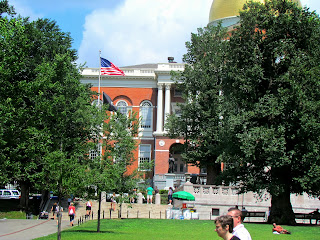
State house. Built in 1798, the "new" State House is located across from the Boston Common on the top of Beacon Hill. The land was once owned by Massachusetts first elected governor, John Hancock. Charles Bullfinch, the leading architect of the day, designed the building.

Beacon Hill Beacon Hill gets its name from a beacon that once stood atop its hill to warn locals about foreign invasion. Its architecture and lay- out is reflective of old colonial Boston, consisting of brick row houses with beautiful doors, decorative iron work, brick sidewalks, narrow streets, and gas lamps.

Entrance to house on Beacon Hill

Impressive fire trucks

Paul Revere House

The ranger telling stories. The ranger appointed two girl twin one Loyalist: Thomas Hutchinson and one patriot: Paul Revere.
 Thomas Hutchinson (governor), Thomas Hutchinson (9 September 1711 – 3 June 1780) was a businessman, historian, and a prominent Loyalist politician of the Province of Massachusetts Bay in the years before the American Revolution. A successful merchant and politician, Hutchinson was active at high levels of the Massachusetts government for many years, serving as lieutenant governor and then governor from 1758 to 1774. He was a politically polarising figure who, despite initial opposition to Parliamentary tax laws directed at the colonies, came to be identified by John Adams and Samuel Adams as a proponent of hated British taxes. Hutchinson exemplifies the Loyalist-as-loser. He sacrificed his love for Massachusetts to his uncritical loyalty to Great Britain, where he spent his last years in unhappy exile.

Paul Revere (December 21, 1734 – May 10, 1818) was an American silversmith, early industrialist, and a active in the American Revolution. He is most famous for alerting the Colonial militia to the approach of British forces before the battles of Lexington and Concord. Revere was a prosperous and prominent Boston silversmith, who helped organize an intelligence and alarm system to keep watch on the British military. Following the war, Revere returned to his silversmith trade and used the profits from his expanding business to finance his work in iron casting, bronze bell and cannon casting, and the forging of copper bolts and spikes. Finally in 1800 he became the first American to successfully roll copper into sheets for use as sheathing on naval vessels.

Some Canadian geese (Branta canadensis) we meet on our evening walk in the harbour

Evening atmosphere in the harbour

A monument not connected to the uprising against British rule in Boston, but a gift from the Armenian-American community of Massachusetts to recognise that Massachusetts has offered hope and refuge for emigrants from all over the world and in honor of the Armenian Genocide 1915-1923.
 Boston National Historical Park has a Visitor Center in,
Faneuil Hall. Faneuil Hall has served as a marketplace and a meeting hall since 1742. It was a much smaller 2 storey building by then. Funding was provided by a wealthy merchant, Peter Faneuil. Puritan landowners of the city gathered there to decide about the city’s affairs. The Inspirational speeches by Samuel Adams and other puritans were given at Faneuil Hall. These oratories promoted their desire to obtain independence from the British to promote their business interests. Boston National Historical Park has a Visitor Center in Faneuil Hall from where they organise historical walks to the major attractions.
Boston National Historical Park has a Visitor Center in,
Faneuil Hall. Faneuil Hall has served as a marketplace and a meeting hall since 1742. It was a much smaller 2 storey building by then. Funding was provided by a wealthy merchant, Peter Faneuil. Puritan landowners of the city gathered there to decide about the city’s affairs. The Inspirational speeches by Samuel Adams and other puritans were given at Faneuil Hall. These oratories promoted their desire to obtain independence from the British to promote their business interests. Boston National Historical Park has a Visitor Center in Faneuil Hall from where they organise historical walks to the major attractions.
 The marked behind Faneuil Hall which offers a great variety of food and drink and souvenirs, and is extremely popular among local and tourist alike.
 The old state hall. Also known as Boston's "Towne House", the Old State House dates back to 1713. This Georgian style structure was occupied by the British during the Revolution and was a continuous reminder to the settlers of British dominance and presence in the colony.
The Old State House was the center of all political life and debate in colonial Boston. On top of the building the British Lion and the Scottish Unicorn.
The old state hall. Also known as Boston's "Towne House", the Old State House dates back to 1713. This Georgian style structure was occupied by the British during the Revolution and was a continuous reminder to the settlers of British dominance and presence in the colony.
The Old State House was the center of all political life and debate in colonial Boston. On top of the building the British Lion and the Scottish Unicorn.
 The old south meeting house.Old South Meeting House a Puritan church was built in 1729. Old South Meeting House has played an important role in American history. In the years leading to the American Revolution, thousands of colonists gathered at Old South Meeting House to challenge British rule, most famously to protest the Boston Massacre and the tea tax. The largest building in colonial Boston, Old South Meeting House was the stage for an overflow meeting on December 16, 1773, which adjourned to Griffin’s Wharf for the infamous event that would become known as the Boston Tea Party.
 The top of a gravestone from the old puritan graveyard.
 State house. Built in 1798, the "new" State House is located across from the Boston Common on the top of Beacon Hill. The land was once owned by Massachusetts first elected governor, John Hancock. Charles Bullfinch, the leading architect of the day, designed the building.
 Beacon Hill Beacon Hill gets its name from a beacon that once stood atop its hill to warn locals about foreign invasion. Its architecture and lay- out is reflective of old colonial Boston, consisting of brick row houses with beautiful doors, decorative iron work, brick sidewalks, narrow streets, and gas lamps.
 Entrance to house on Beacon Hill
 Impressive fire trucks
 Paul Revere House
 The ranger telling stories. The ranger appointed two girl twin one Loyalist: Thomas Hutchinson and one patriot: Paul Revere.
 Thomas Hutchinson (governor), Thomas Hutchinson (9 September 1711 – 3 June 1780) was a businessman, historian, and a prominent Loyalist politician of the Province of Massachusetts Bay in the years before the American Revolution. A successful merchant and politician, Hutchinson was active at high levels of the Massachusetts government for many years, serving as lieutenant governor and then governor from 1758 to 1774. He was a politically polarising figure who, despite initial opposition to Parliamentary tax laws directed at the colonies, came to be identified by John Adams and Samuel Adams as a proponent of hated British taxes. Hutchinson exemplifies the Loyalist-as-loser. He sacrificed his love for Massachusetts to his uncritical loyalty to Great Britain, where he spent his last years in unhappy exile.
 Paul Revere (December 21, 1734 – May 10, 1818) was an American silversmith, early industrialist, and a active in the American Revolution. He is most famous for alerting the Colonial militia to the approach of British forces before the battles of Lexington and Concord. Revere was a prosperous and prominent Boston silversmith, who helped organize an intelligence and alarm system to keep watch on the British military. Following the war, Revere returned to his silversmith trade and used the profits from his expanding business to finance his work in iron casting, bronze bell and cannon casting, and the forging of copper bolts and spikes. Finally in 1800 he became the first American to successfully roll copper into sheets for use as sheathing on naval vessels.
 Some Canadian geese (Branta canadensis) we meet on our evening walk in the harbour
 Evening atmosphere in the harbour
 A monument not connected to the uprising against British rule in Boston, but a gift from the Armenian-American community of Massachusetts to recognise that Massachusetts has offered hope and refuge for emigrants from all over the world and in honor of the Armenian Genocide 1915-1923.