Apr 19, 2016
The south-east coast of the Danish island Langeland, April 17, 2016
It was a popular place for German sports fishers
White wagtail , Vipstjert
Primrose, Kodriver
View from Fakkebjeg (the Mountain of Fakke)
Mar 28, 2016
Birds from my living room, spring 2016
We live in a house in the outskirts of Rudkøbing, the main town on the small Danish island Langeland (the long island).
Langeland is very rich in bird life, and a few of passes our house and is observed. Most of them members of the Crow family and sea gulls (not really worth a photo!)
Eurasian wigeon, Pibeand, 2016-01-09
Greylag goose, Grågæs, 2016-01-13
Northern lapwing, Vibe, 2016-02-17
Common shelduck, Gravand and Black-headed gull, Hættemåge, 2016-03-08
White Tailed Eagle, Havørn. I have allways wanted to get close to eagles, but it when we moved to Langeland a couple of years ago I succeeded. We have to permanent pair, many passing and some trying to establish themselves as new breeding pairs. Sitting on our terrace enjoying a nice spring day in the sun, we observed 4 white tailed eagles high in the air. They even made some aerial acrobatics holding each-others claws and tumbling down, 2016-03-20
Eurasian oystercatcher and White wagtail; Strandskade og Hvid Vipstjert, 2016-03-24
Black-headed gull, Hættemåge, 2016-03-25
Mar 21, 2016
Seminar: How do the Danes use their tax money? – and why do they accept to pay the highest taxes in the world?
The Ørsted school in Rudkøbing is Langeland's newest school, built in 2007. The school was inaugurated in 2010. The Ørsted school built as a public-private partnership (PPP). Photo February 29, 2016. ooooooooooooooooooooooooooooooooooooooooooooooooooooooooo
1. Introduction
The aim of the seminar is to tell "speechless" foreigners why the Danes agree to pay so much in taxes (and if they really accept it!), and what we Danes get for our tax-money.
Taxation is a very controversial issue in many countries including USA. The tremendous growth in inequality in the United States over the past decades, has been highlighted by US presidential candidate Bernie Sanders. Bernie Sanders has repeatedly stressed Denmark as an example of what he will do with the United States if he becomes president. Denmark has been a hot topic in the US election. But Bernie haven’t put much focus much on the level of taxation needed to finance the high level of public service and social security in Denmark.
The seminar on the Danish public service and taxation will take place on the Danish island of Langeland (the Long Island) and in Copenhagen, and will provide the participants (the "speechless" foreigners) an impression of how the state collects taxes and how the state and the municipalities spend the money.
Tranekær Castle, seen from the castle park. On Tranekær Castle, Langeland the count and countess arranges meetings where guests stay in at a castle steeped in history, set in spectacular surroundings and every visitor will encounter an unsurpassed level of service. (http://tranekaergods.dk/uk/). Photo February 28, 2016.ooooooooooooooooooooooooooooooooooooooooooooooooooooo
2. The highest taxed spot on earth
As the municipal tax on Langeland is the highest of all the 98 municipalities in Denmark, and as Denmark has the highest taxes in the world, it is fair to say that the small island of Langeland is the highest taxed spot on earth.
The seminar tells about the "Danish model" of taxation and public spending. The story will be told partly on Langeland and partly in Copenhagen.
Langeland municipality has its offices in the former hospital in Rudkøbing. Soon we, Long Islanders, has to drive 50 kilometers to Odense, the nearest bigger city, if we have an illness that requires hospitalization. ooooooooooooooooooooooooooooooooooooooooooooooooooooooooo
3. Program
The seminar is scheduled to last for 8 days:
- Day 1: Pick up of participants, accommodation in Copenhagen, introduction to the course.
- 2nd day to 4th day: On Langeland (the world's most heavily taxed spot), if possible accommodation in Tranekær Castle. Lectures by distinguished experts and discussions on the Danish model. Visit to local institutions to give an impression of what the inhabitants of Langeland get for their tax money. Opportunity for individual sightseeing on the beautiful island of Langeland.
- 5th to 8th day: in Copenhagen. Lectures distinguished experts and discussions on the Danish model. Visits to institutions and the Danish Parlament. Opportunity for individual sightseeing in Copenhagen.
Nyhavn in Copenhagen, once a red light district filled with taverns, today popular among tourists. Photo June 27, 2015. ooooooooooooooo
4. Content - possible topics
The seminar will alternate between presentations, discussion and work groups - if participants are interested in this type of work.
Suggested topics:
1. Why accept the Danes the world's highest taxes?
2. How collects public money - how much is income tax, other taxes, VAT etc. Where does the money go? State and municipal spending.
3. How much of the total GDP in Denmark goes to public service?
4. How much that taxes goes to "service for all" and how much to equalize social differences?
5. Is there a reasonable balance between the part of the income that goes to taxes (incl. VAT and excise duties) and the part that is available for individual consumption? - Representatives of the parties represented in the Danish Parliament gives their view.
6. Corruption in DK - how and how much - level compared to other countries? - Transparency DK
7. Confidence - the importance of confidence for the "Danish model".
8. Equalizing the municipal service between rich and poor municipalities.
9. The center and periphery - how is it addressed in DK?
10. Langeland Municipality's budget - the expenditure and revenue side.
11. Copenhagen Municipality's budget - the expenditure and revenue side.
12. How is the money spent? - Visits to public institutions in the two municipalities.
13. The educational system.
14. Families with small children – public kindergartens.
15. Service for the poor, weak and old.
16. The social security. Percentage of 18-65 year outside the labor market an hoe are they taken care of?
17. The Danish labor market - how to define wages, and how do you avoid labor conflicts
18. The development of trust in politicians.
19. Can the "Danish model" resist pressure from refugees, immigrants and workers from the EU with lower wage levels and other social security?
20. What are the possibilities for doing business in Denmark compared to other countries (f.ex.: USA, UK, D, S, AUS)?
A small Langeland kindergarten, located in the village Simmerbølle. Photo February 28, 2016. oooooooooooooooooooooooooooooooooooooooooooooooo
References:
i. http://www.dr.dk/nyheder/udland/lektor-amerikansk-ulighed-goer-danmark-til-forbillede-praesidentkandidat
ii. http://edition.cnn.com/2016/02/17/politics/bernie-sanders-2016-denmark-democratic-socialism/
iii. http://www.information.dk/539713
iv. https://en.wikipedia.org/wiki/Taxation_in_Denmark
v. http://www.skat.dk/skat.aspx?oId=2068705&vId=0
vi. http://www.taxindenmark.com/article.65.html
vii. http://money.cnn.com/2013/04/01/pf/taxes/top-income-tax/
viii. http://www.frugalconfessions.com/miscellaneous/denmark-highest-tax-rate-and-happiest-people.php
There is plenty of wind and wind turbines on Langeland, and Langeland export green power. Photo February 28, 2016. ooooooooooooooooooooooooooooooooooooooooooooooooooooooooo
The proposal for the seminar on the Danish model is part of a strategy for self-reliant development of Langeland, see: http://langelandsstrategi.blogspot.dk/2015/12/vi-skal-hive-os-op-ved-haret- en.html (in Danish)
Jan 3, 2016
A walk a cold January day, Sunday, January 3, 2016, Langeland, Denmark
It was a great but also a cold pleasure to walk along the beach just south of Rudkøbing in the strong wind and with temperatures below zero.
Red-breasted Merganser
Dec 10, 2015
Portugal, Algarve, Ludo Trail, Ria Formosa Natural Park, Nov. 20, 2015
The last day of our holiday we again had very nice weather, and a nice walk along the Ludo Trail just west of the Faro Airport. The trail is situated in the Ria Formosa Natural Park,
The Ria Formosa Natural Park is a barrier between the Atlantic and the mainland and is further protected by several islands, which are basically large sand dunes.
In between these islands and the mainland are large areas of dunes and lagoons, small sand isles, mud flats and canals. This provides a wonderful habitat for flora and fauna, especially birds.
We parked next to the airport and walked on the trail in the direction west. Unfortunately we did not have time to walk the two other legs to the north, and we did not get a close look at the flamingoes.
On our way
The northern shoveler (Anas clypeata), skeand.
The Eurasian wigeon, (Anas penelope), Pibeand
Flamingos in the distance
The white stork (Ciconia ciconia)
Ringed Plover (Charádrius hiaticula), Stor præstekrave
The trail over the lagoon to the barrier island and the beach.
The beach
Ruddy turnstone, (Arenaria interpres), Stenvender
Everywhere on the shallow mudflats you find people collecting mussels and worms for bait
Common redshank (Tringa totanus), Rødben
Western swamphen (Porphyrio porphyrio), Sultanhøne
Azure-winged magpie (Cyanopica cyanus), Blåskade
Hoopoe (Upupa epops), Hærfugl
Little grebe (Tachybaptus ruficollis), lille lappedykker
The common greenshank (Tringa nebularia), Hvidklire
Dec 3, 2015
Portugal, Algarve, Quinta do Marin, Nov. 19, 2015
Parque Natural da Ria Formosa is situated just east of Olhao.
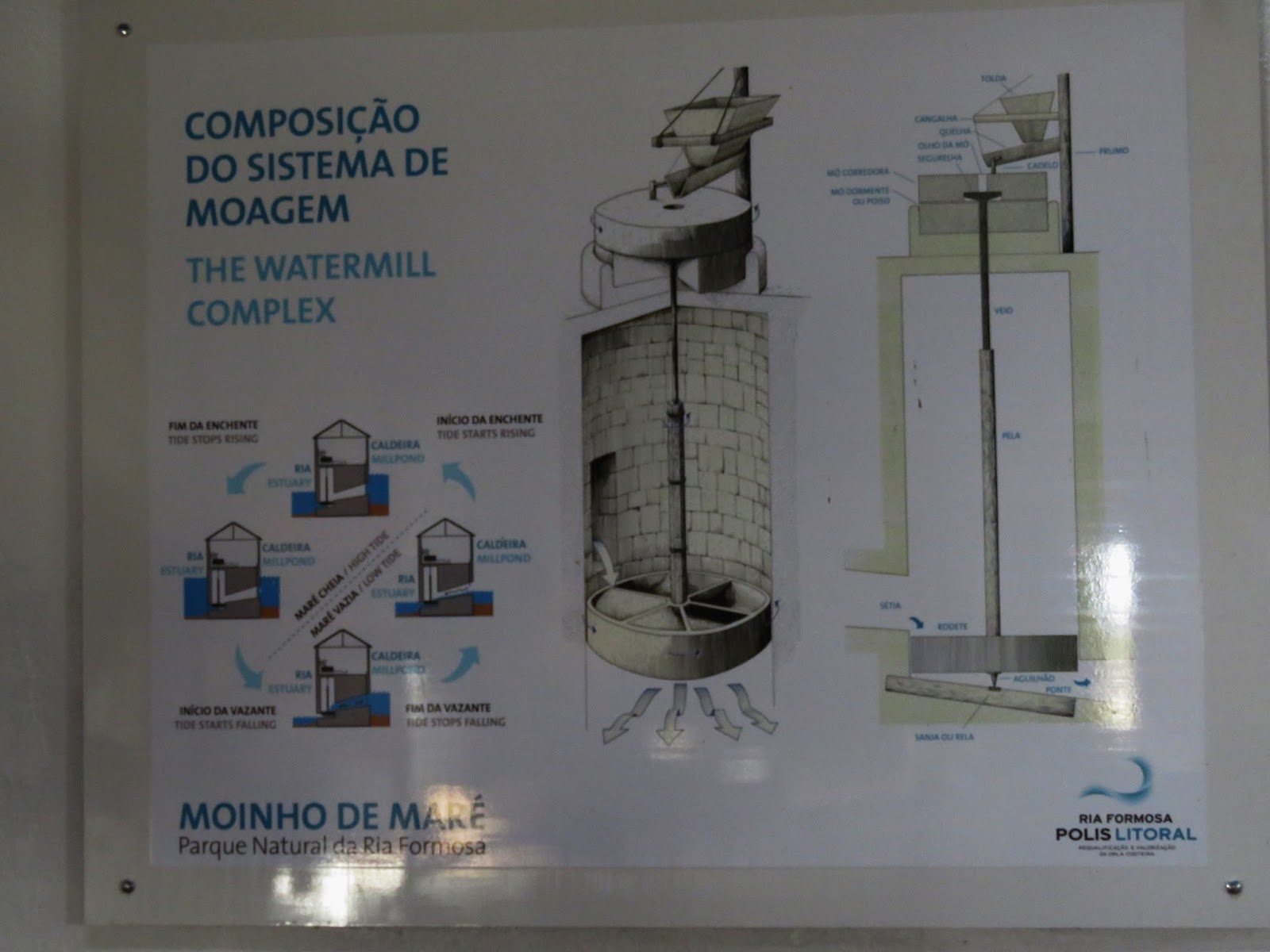
The trail included a historic tide mill.
A grey heron (Ardea cinere) welcomed us to the trail
The old tidal mill had been restored
The reservoir of the tidal mill
A view of the Ria Formosa
European golden plover (Pluvialis apricaria), Hjejle. European golden plover is disappearing as breeding population in Denmark
Inside the old tidal mill, reading the information
This is how the tidal mill worked
Pond with an impressive amount of ducks
Gadwall, (Anas strepera), Knarand , male and female
Gadwall, (Anas strepera), Knarand, male
The common pochard (Aythya ferina) is a medium-sized diving duck. Navnet taffeland refererer til, at man før i tiden anså taffelanden for at være en meget velsmagende fugl - lige til et veldækket taffel!
Subscribe to:
Posts (Atom)