Apr 15, 2012

Valldemossa, Thursday, 5th of April.

On the fifth day we planned to walk from Valldemossa to Deia. We took the bus to Valldemossa. But when we were ready to start our hike it also started to rain very heavily and we gave up and took the bus back after doing some sightseeing in Valldemossa.


A beautiful town in north-west Majorca, Valldemossa is the highest community on the island and sits on the slopes of the Tramuntana mountains.


Valldemossa gained some sort of fame when Polish composer Frederic Chopin came and stayed at the Carthusian monastery (Cartoixa Reial) with his lover George Sand in the winter of 1838-39.
The monastery had been turned into rented accommodation three years earlier during the suppression of the monasteries - the monks had been there since 1399 - and Chopin and Sand were in the vanguard of the area's tourist development.
The composer had tuberculosis but still managed to produce some of his best work here, while Sand wrote an epistle called 'A Winter in Majorca ' about their experiences. She sniped mercilessly at the locals, while admiring the region's beauty. " Anything that can be dreamt by the painter or the poet has been created by nature in this place," she wrote.

From Soller up in the mountains,Wednesday, 4th of April.

On the fourth day we took the tram to Soller and went from there up the mountains, Wednesday, 4th of April.


The Soller valley and its surrounding mountain range, the 'Serra de Tramuntana', a UNESCO World Heritage Site, is a favourite destination for people from who enjoy walking, nature and a peaceful rest away from the hustle and bustle of the better-known tourist traps on Majorca.


Situated some 3 Km. inland from its port, 'Port de Sóller', the town lies in a large, fertile, bowl-shaped valley. Sóller shares its valley with the village of Fornalutx and the hamlet of Biniaraix, the combined population is around 13,000, and the valley is famous for its orange groves and terraces of ancient olive trees.

View from the Tramuntana mountains down to Soller.


Waiting for the bus in Biniaraix.

Apr 13, 2012

From Port de Sóller to Cala Tuent, Tuesday, 3rd of April

On the third day we also went on a guided tour. This time to the bay of Cala Tuent

There is a system of watchtowers around Port de Soller to warn about pirates. This is the one just above Port de Soller. It was in connexion (by fire and smoke) with other watchtowers along the coast, and the Finca, which was now our hotel, would gather the local population for resistance if the pirates would approach

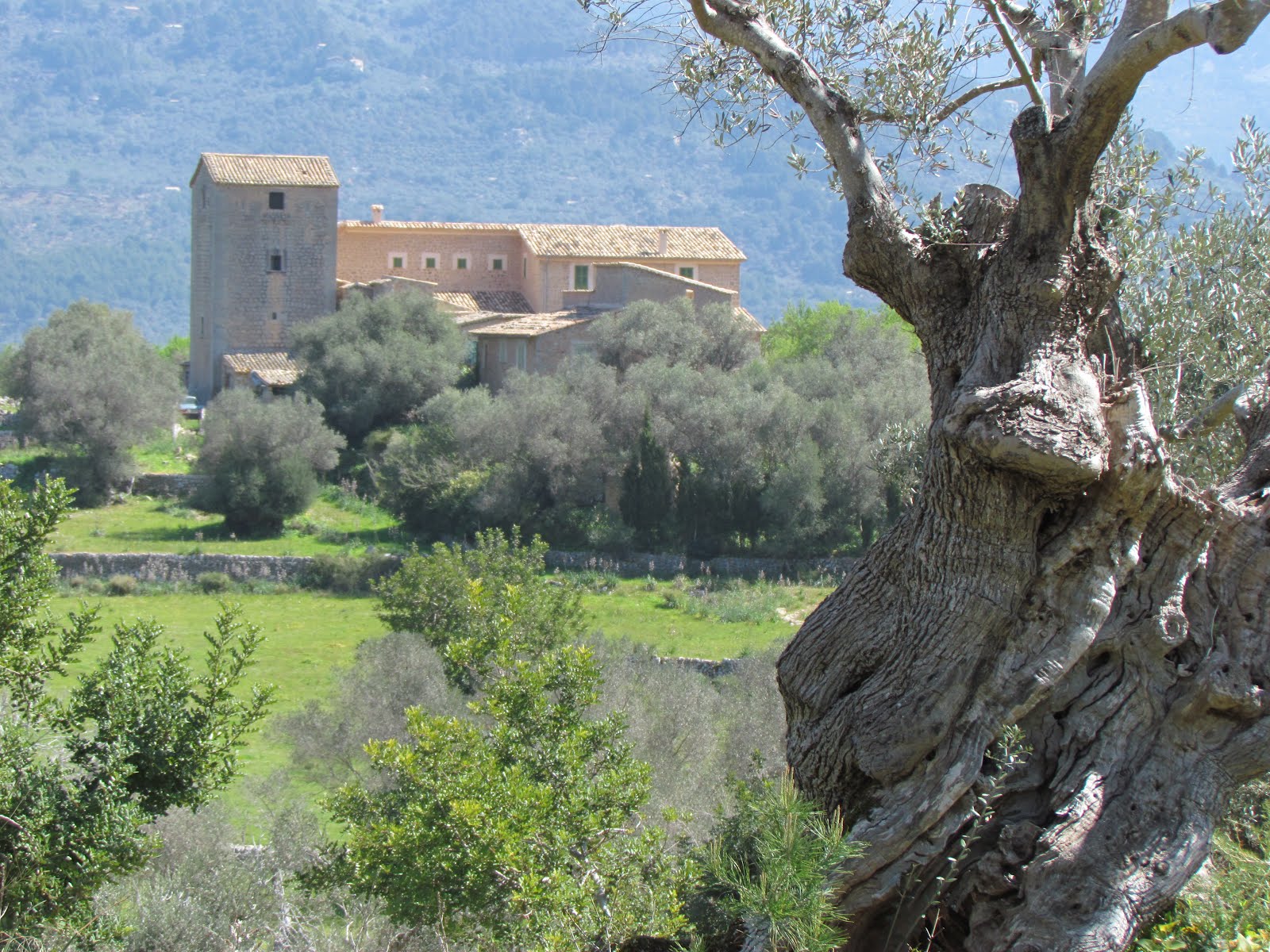
We passed three Fincas on the way to Cala Tuent.

Fincas are typically situated where there was a natural spring. Our guide brought her dog Daisy with her.

Olive trees comes in all shapes.

The third Finca.


Just above the bay there was another watchtower.


When we reached Cala Tuent we had a refreshing swim.

We went back to Port de Soller by boat.

Fornalutx, Monday, 2 April.

On the second day we went on a guided tour to the small village of Fornalutx, Monday, 2nd of April.


Fornalutx is a much-visited colourful village located in the Valley of Sóller, in the centre of the Serra de Tramuntana mountains. Its origins go back to the Middle Ages and it grew up around the site of a primitive Moorish farmstead, as is indicated by the old streets in the highest part of the village, which are narrow, winding and steep.


Nearly all the stone streets of Fornalutx are stepped and are reserved exclusively for pedestrians. The entire village is of great architectural and aesthetic interest, with buildings kept in fine condition. The stone entrances, the austerity and simplicity of constructions, together with their ornamentation, mean that the houses of Fornalutx are fine examples of traditional Mallorcan mountain architecture, reflecting life in times gone by. The village is linked to agriculture, with vegetable, orange and olive cultivation being the driving force behind the economy until the 1960s, just as in the rest of the Valley of Sóller.

To Deia, Sunday, 1st of April — at Majorca,Spain.

Our first day we went along the cost from Port de Soller to Deia

Deià is known for its literary and musical residents. Its idyllic landscape, orange and olive groves on steep cliffs overlooking the Mediterranean, served as a draw for German, English, and American expatriates after the first World War.

The English poet, novelist, and scholar, Robert Graves, was one of the first foreigners to settle in the village, where he collaborated with Laura Riding in setting up the Seizin Press. Graves returned after the war and remained in Deià until his death. He used the town as the setting for many of his stories, including the historical novel Hercules my Shipmate. His house is now a museum.

Anaïs Nin visited the village in the 1920s, and she wrote a short story set on the village's beach. The Spanish writer, Carmen Naranjo, recently wrote a short story about Nin's. The town is also the unnamed setting of the Uruguayan novelist, Cristina Peri Rossi's "The Ship of Fools" (La nave de los locos). The Nicaraguan poet and novelist, Claribel Alegría, lives in Deià today.

In recent decades, the stars of literature have been eclipsed by the stars of rock and roll. The Virgin Records mogul, Richard Branson, has a luxury residence in the town, and his label's stars have often visited the village and sometimes jammed at the local bar, 'Sa Fonda'. Deià was home to several Canterbury-scene musicians over the years, including Kevin Ayers, Robert Wyatt, and Daevid Allen. Mick Jagger, guitarist Mark Knopfler, and European-music icon Mike Oldfield played there often in the late 1980s.


Robert Graves discovered Deia’s charming in 1946 and made it his home it became an artist meeting point and inspiration place. Now, while it keeps its mallorcan character, it is also the place to luxurious hotels and a millionaires home.

Port de Soller; Majorca, April 2012.

Port de Sóller is a village and the port of the town of Sóller, in Majorca, in the Balearic Islands, Spain. A tramway links the inland town of Sóller to Port de Sóller, running along the beach-side road.
The resort consists of shops, restaurants and bars. Two lighthouses sit on the headlands on either side of the bay, La Badia de Sóller.
The tramway connecting the town to Sóller opened in 1913 and is about 5 km long. Some of its original, 1913-built cars are still in service on the line.


At our favourite restaurant in Port de Soller “Lua”, also from the guidebook: “Walk and eat in Majorca”

View from the restaurant


Es Port Soller Hotel, 31 March 2012.

Our hotel, Es Port Soller Hotel, is an old mansion fortified in the 17th century at Puerto de Sóller at the foot of the Sierra de Tramuntana Mountains and a few metres from the Mediterranean Sea.


The original building is the entrance to the hotel

We were so lucky to get a room next to the old living room for the owner of the mansion (or Finca), that probably was an original bedroom.


Port de Soller and Es Port Hotel Part of the old equipment for the production of olive oil is still in the hotel as decoration.
First the olives have to be grinded.
Production of olive oil has been the main occupation in this part of Majorca. Every Finca has had its own equipment for the production of olive oil.
Now there is only two left in the area and they produce mainly for the local marked.


The equipment used to press the oil from the grinded olives


Port de Soller and Es Port Hotel